
The ISP & network engineering guide
Practical, vendor-neutral guides on network design, fiber, routing, hardware and operations — for ISP operators and network engineers worldwide.
ISP Network Topologies Explained: Star, Ring, Mesh and Hybrid
A practical, vendor-neutral deep dive into the topologies ISPs actually build — star, ring, mesh and hybrid — with diagrams, a comparison table, failure behaviour, and how to choose by cost, resilience and scale.
Network Design
PPPoE vs IPoE: How ISPs Authenticate and Manage Subscribers
PPPoE binds identity to an explicit session; IPoE binds it to the access port and DHCP option 82. The choice quietly dictates your BNG scaling ceiling, your accounting accuracy, and how a missed payment turns into a disconnection.
Read article
What Is CGNAT and Why Growing ISPs Can't Avoid It
Carrier-Grade NAT lets a handful of public IPv4 addresses serve thousands of subscribers — but it does so by rationing ports, breaking inbound connections, and saddling you with a logging burden. Here is how to size it, what it breaks, and why IPv6 is the only real exit.
Read article
Building Redundancy: Removing Single Points of Failure in an ISP Network
Resilience isn't a product you buy — it's the disciplined elimination of every place where one failure takes down service, spent in proportion to each failure's blast radius. A practical, layer-by-layer playbook for ISP operators.
Read article
VLANs and Q-in-Q: Segmenting an ISP Network
VLANs carve one physical network into many logical ones, but the ~4,094-tag ceiling stops an ISP cold. Q-in-Q stacks a second tag to multiply that space and carry customer VLANs transparently across your core — here's how both work and how to keep them disciplined.
Read article
NAT Explained: Types of NAT and Where ISPs Use Them
Static, dynamic, PAT and CGNAT all rewrite addresses, but they consume state, ports and public IPs in very different ways. A precise look at each type, where ISPs actually deploy it, and why IPv6 is the endgame.
Read articleFiber & Access
GPON vs Active Ethernet: Choosing Your FTTH Architecture
A detailed, vendor-neutral comparison of the two main fiber-to-the-home architectures — passive GPON and point-to-point Active Ethernet — with a diagram, comparison table, contention and troubleshooting trade-offs, and how to choose.
Read article
OLT, ONU and ONT Explained: The Building Blocks of a GPON Network
How the OLT, passive splitter and ONT chain together to feed thousands of subscribers from one fiber — and why understanding this chain turns optical-power faults into a five-minute lookup instead of a blind truck roll.
Read article
Fiber, Copper or Wireless: Choosing Your Last-Mile Technology
The last mile consumes most of an ISP’s capital and generates most of its support tickets. A working comparison of fiber, DSL copper and fixed wireless — capacity, latency, lifespan, deploy time — and the honest answer about when each one actually wins.
Read article
Understanding Optical Power Budget in a Fiber Network
Most fiber faults are really power problems in disguise. Learn to think in light levels — transmit power, receiver sensitivity, and every dB lost along the way — so “the link is down” becomes a methodical check instead of a blind truck roll.
Read article
FTTH, FTTB and FTTC: Fiber Deployment Models Explained
“Fiber” means different things depending on how far the glass actually reaches before the signal switches to copper or in-building wiring. How far you push it — to the home, the building or the curb — shapes cost, capacity and how future-proof the network really is.
Read article
Splicing, Connectors and Patch Panels: Fiber Plant Basics
You can design a flawless network on paper and still run a flaky one in the field. Most fiber faults aren’t exotic — they’re a dirty connector, a bad splice or a tight bend. A field primer on fusion splices, connectors, labelling discipline and keeping the glass alive.
Read articleRouting & Core
BGP for ISPs: A Plain-English Introduction (and Why You Need an ASN)
BGP is the path-vector protocol that stitches 70,000+ independent networks into one internet. Here is how reachability and path selection actually work, why your own ASN and provider-independent address space change everything, and how to multihome and filter without becoming the next routing-leak headline.
Read article
What Is a BNG (Broadband Network Gateway) and Where It Fits
The BNG is the box where raw access lines become managed, billable subscriber sessions — terminating PPPoE/IPoE, authenticating against RADIUS, assigning addresses, enforcing speed profiles, and metering usage. Here is exactly what it does, why it is both a scaling chokepoint and a single point of failure, and how to make it survive failure.
Read article
How to Plan IP Addressing for an ISP
A clean addressing plan keeps routing tables small, troubleshooting fast, and growth painless; a sloppy one means constant renumbering and confusing outages. Here are the principles — separating infrastructure from subscribers, allocating for aggregation, leaving real growth headroom, and deploying IPv6 properly the first time.
Read article
What Is MPLS and Do You Need It as an ISP?
MPLS forwards packets on short labels instead of repeated destination lookups, unlocking traffic engineering, L2/L3 VPNs, and sub-second fast reroute. But it adds real operational weight. Here is how label switching actually works, what it buys you, where it fails in production, and how to tell whether you have crossed the threshold where it earns its complexity.
Read article
Peering vs Transit: How ISPs Connect to the Rest of the Internet
Transit buys you reachability to every network on Earth through one contract; peering swaps traffic directly with a single network for free. Most ISPs run both, and the ratio between them quietly governs your cost per megabit, your latency, and how gracefully you survive an outage.
Read article
What Is an IXP (Internet Exchange Point) and Why Join One
An Internet Exchange is a shared switching fabric where you connect once and peer with dozens or hundreds of networks over a single port. For a growing ISP it is often the single highest-return infrastructure decision available — cutting transit cost and latency at the same time.
Read article
OSPF and IS-IS: Interior Routing Protocols for ISPs
BGP connects you to the world, but inside your own network you need an Interior Gateway Protocol to find the best path between your own routers. This is a practical comparison of OSPF and IS-IS, how link-state routing actually works, and the one design rule that keeps either of them stable: never pour BGP routes into your IGP.
Read article
BGP Communities and Route Filtering: Controlling Your Routing
Running BGP is the easy part; controlling it is what separates a stable network from a source of internet incidents. This guide covers inbound and outbound filtering, RPKI and max-prefix safeguards, and how communities, local-pref, and AS-path prepending let you steer traffic with intent.
Read articleHardware
MikroTik vs Cisco vs Juniper: Choosing Routers for Your ISP
A balanced, vendor-neutral breakdown of how MikroTik, Cisco and Juniper differ on capability-per-dollar, hardware forwarding capacity, ecosystem and support model — and where each one genuinely earns its place in an ISP, layer by layer.
Read articleHow to Choose a Router for Your ISP: Throughput, Sessions and Features
The specifications that actually decide whether a router survives production: real small-packet throughput with features enabled, hardware versus software forwarding, NAT-translation and route-table scale, subscriber capacity, and the uplink headroom and operability that separate a good buy from an expensive replacement.
Read article
Routers, Switches and OLTs: What Each Does in an ISP Network
Switches move traffic within a network at layer 2, routers move it between networks at layer 3, and OLTs drive the fiber access head-end — confusing these roles is a leading cause of slow, costly and unmanageable ISP designs. Here is what each device decides and where it belongs.
Read articleSFP Optics Explained: A Practical Primer for ISPs
The pluggable modules in your switches and routers quietly decide your reach, speed and a slice of your budget. A practical look at the specs that matter — speed, reach, fiber type and wavelength — plus BiDi and WDM to stretch fiber, DOM/DDM diagnostics, connector cleanliness and vendor coding.
Read articleUPS and Power Protection for ISP Sites
Power is the failure that takes everything down at once, and the protection against it is some of the cheapest reliability you can buy. A practical guide to layering UPS, generators and redundant feeds, sizing by both load and runtime, prioritising by blast radius, and the testing discipline that separates real protection from expensive scenery.
Read articleOperations
Monitoring an ISP Network: SNMP, NetFlow and the Metrics That Matter
A working ISP monitoring stack is five layers, not one tool: availability, SNMP performance trends, flow telemetry, subscriber-session state, and impact mapping. This guide explains what each layer catches, where each one fails, and how to alert without burning out on-call.
Read article
QoS and Bandwidth Management for ISPs: Fair Usage Without the Complaints
Bandwidth is the product, and peak hour is when it gets tested. This guide breaks down the levers ISPs actually pull — speed profiles and burst, contention ratios, fair-usage policy, and QoS prioritisation — and how each one fails when it is tuned by guesswork instead of measurement.
Read article
Scaling an ISP from 500 to 30,000 Subscribers: What Breaks and How to Fix It
Growth does not break an ISP all at once — it breaks one quiet assumption at a time. This field guide walks through what fails at scale in billing, provisioning, support, the network, and accounting, and the single cure underneath all of them: automating the repeatable.
Read article
DDoS Mitigation for ISPs: A Practical Baseline
For an ISP, DDoS is routine weather, not an exotic threat. This guide lays out a layered baseline any ISP can grow into — flow-based detection, BCP 38 anti-spoofing hygiene, remote-triggered blackhole for volumetric floods, and scrubbing to protect victims — plus a runbook for the moment it matters.
Read article
Why IPv6 Matters for ISPs (and How to Start)
IPv6 is not a someday project — it is how growing ISPs escape IPv4 scarcity and cut their dependence on expensive, ticket-generating CGNAT. The practical case for deploying it, why dual-stack is the low-risk path, and a sane sequence for starting.
Read article
RADIUS and AAA: How ISPs Authenticate and Account for Subscribers
RADIUS carries the three A's — authentication, authorization and accounting — between your BNG and your subscriber database in milliseconds. This is how the exchange works, why it is the seam between billing and the network, and how to keep it standing during a login storm.
Read article
DNS for ISPs: Recursive Resolvers, Caching and Why They Matter
DNS is the first thing every customer touches and the first thing they blame when the internet feels slow — even when your bandwidth is fine. How recursive resolvers and caching work at ISP scale, why running your own pays off, and how to keep them fast, redundant and safe.
Read article
Capacity Planning for ISPs: Staying Ahead of Growth
Run out of capacity and customers feel it every evening; over-build and you have parked cash in idle links. How ISPs upgrade on data instead of guesswork — measuring peaks not averages, planning against thresholds with real lead time, and leaving headroom for the failure case.
Read articleISP Business
The Hidden Costs of Manual ISP Billing
Manual ISP billing may look simple, but it leads to revenue loss, billing errors, delayed payments, and higher admin workload. Learn the real cost.
Read article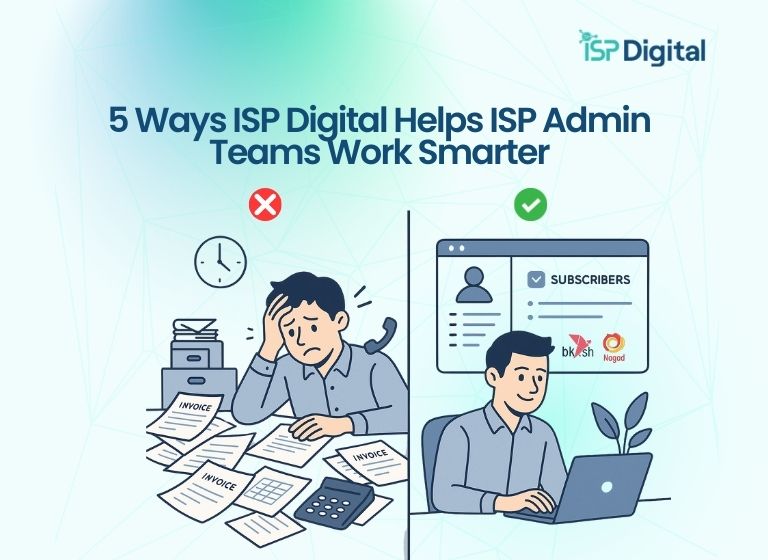
5 Ways ISP Digital Helps ISP Admin Teams Work Smarter
Learn 5 ways ISP Digital saves admin teams time and reduces errors. Features include billing automation, bKash/Nagad payments, reseller tools, and BTRC compliance.
Read article
Why Poor Subscriber Management Is Costing You Customers
Poor subscriber management causes churn and lost revenue. Learn how ISP CRMs with Mikrotik/OLT integration, reseller tools, and BTRC compliance keep ISPs growing.
Read article
Common ISP Billing Mistakes Made by ISPs (And How to Fix Them)
Learn the most common ISP billing errors and how automation fixes them. See how features like auto-invoicing, reminders, and digital payments help ISPs grow.
Read article
Why ISP Digital is the Best Billing Software for Your ISP
Looking for the best ISP billing software? ISP Digital handles auto billing, disconnections, user tracking, and BTRC reporting—built for Bangladeshi ISPs.
Read article
How ISP Digital Handles Recurring Billing for ISPs
Explore how ISP Digital automates and simplifies recurring billing for ISPs using MikroTik.
Read article
5 Reasons to Choose ISP Digital Over Competitors
See why ISP Digital stands out among billing software competitors in Bangladesh.
Read article
5 Signs Your ISP Business Needs Billing Automation
Discover key signs that indicate it's time for your ISP to move away from manual billing methods.
Read article
How to Choose the Right ISP Billing Software for Your Business Needs
Learn how to evaluate and choose the best ISP billing software tailored to your business requirements.
Read article
How ISP Billing Automation Can Benefit Your ISP Business
Over 60% of ISPs report major efficiency boosts after switching to automated billing. Here's how ISP billing automation streamlines invoicing, payments, and the full billing cycle for your ISP business.
Read article
Automated ISP Billing vs Manual ISP Billing: What's Better for Your Business?
When it comes to ISP billing, businesses are faced with two key approaches: manual billing and automated billing. Both serve the same core function, but how they do it differs significantly—and the choice can make or break your business operations.
Read article
Importance of Automated Billing for ISPs: Save Time and Money
Managing billing for an Internet Service Provider (ISP) can be a real headache. With so many customers, different payment cycles, and constantly changing…
Read article
What is ISP Billing Software? A Complete Guide for New ISPs
Explore ISP billing software, which simplifies billing tasks, enhances customer service, and ensures accurate revenue management for internet service providers.
Read article