
GPON vs Active Ethernet: Choosing Your FTTH Architecture
When you build fiber to the home, one early decision shapes your cost, capacity and operations for years: do you share one fiber among many homes using passive splitters (GPON), or run a dedicated fiber to each home back to a switch port (Active Ethernet)? Both deliver excellent service. They simply optimise for different things — and understanding the trade-off keeps you from over-building in one place and under-building in another.
GPON: passive optical network
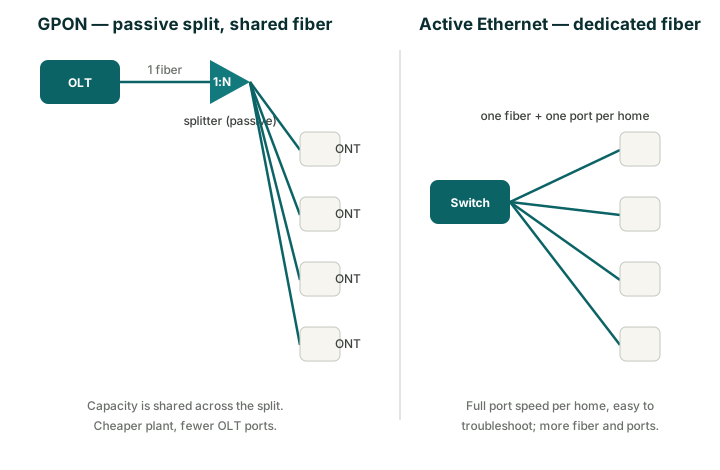
In GPON, a single fiber leaves a port on the OLT (Optical Line Terminal) and is divided by passive optical splitters — devices with no power and no electronics — to serve many homes from that one port. Common split ratios are 1:32 or 1:64, though the practical number depends on your power budget and the distances involved.
Because the split is shared, the capacity of the PON is divided among the subscribers on it. The OLT manages this: downstream, it broadcasts to all ONTs and each takes only its own traffic; upstream, it schedules time slots so subscribers don't collide on the shared fiber. The key economic point is that the outside plant is entirely passive — no power, no active equipment between the OLT and the home — which makes GPON cheaper to deploy and maintain, and lets one OLT port serve dozens of homes. This is why GPON is the dominant choice for residential FTTH worldwide.
Active Ethernet: point-to-point
In Active Ethernet (AE), each subscriber gets a dedicated fiber running back to a dedicated port on an active Ethernet switch. There is no sharing: every customer can receive the full speed of their port, all the time. Troubleshooting is refreshingly simple — one fiber, one port, one customer — and you can upgrade a single subscriber by changing the optics or port at each end, without touching anyone else.
The trade-offs are physical and financial: AE consumes far more fiber, far more switch ports, and requires powered active equipment deeper in the network (which in turn needs power protection and cooling at those sites). For a dense residential rollout, that adds up fast.
Side by side
| Dimension | GPON | Active Ethernet |
|---|---|---|
| Outside plant | Passive (splitters, no power) | Active (powered switches) |
| Fiber per home | Shared feeder + drop | Dedicated end-to-end |
| Cost to build | Lower | Higher |
| Homes per OLT/switch port | Many (e.g. 32–64) | One |
| Dedicated bandwidth | Shared across the split | Full port speed per home |
| Troubleshooting | Needs optical-power awareness across the split | Simple per-port isolation |
| Best fit | Residential mass rollout | Business / high-value / capacity-sensitive |
The real question: contention
The honest difference between the two isn't whether a customer can get fast speed — it's how the shared capacity behaves at peak. On a PON, the homes on a split share capacity, so a heavily loaded PON can feel slower in the evening than a lightly loaded one. For typical residential use, traffic is bursty and rarely peaks all at once, so a sensibly sized split delivers an excellent experience. The discipline is in planning your split ratios and OLT capacity against realistic peak demand — and monitoring PON utilisation so you split or upgrade before customers notice. Business customers, who often want guaranteed, sustained throughput, are a poorer fit for a busy shared PON and a natural fit for AE or a dedicated/higher-tier PON.
Operational differences that bite
The two architectures fail and get fixed differently, and this matters more day-to-day than the headline economics:
- GPON concentrates intelligence at the OLT and pushes loss into the split. Most faults show up as optical-power problems — a dirty connector, a bent drop, a degrading splitter — so reading OLT power readings is how you localise them. (Our guide on optical power budget covers exactly this.)
- Active Ethernet isolates faults to a single port and fiber, which makes diagnosis straightforward, but it means more active devices in the field to power, monitor and maintain.
In both cases, keeping an accurate inventory of which ONT hangs off which OLT port and splitter (or which switch port) turns outage-impact analysis from a guess into a lookup.
An upgrade path, not a dead end
Choosing GPON today doesn't lock you out of higher speeds tomorrow. The PON family has higher-capacity successors (such as XGS-PON) that often reuse the same passive outside plant, letting you raise capacity by upgrading the electronics at the ends rather than re-trenching. That ability to grow on the fiber you've already buried is a big part of GPON's long-term appeal.
What most ISPs actually do
The common, pragmatic pattern is a blend: GPON for the residential mass market, where its economics and density rule, and Active Ethernet (or a higher-tier/dedicated PON) for business, premium and capacity-sensitive customers who will pay for guaranteed throughput. You capture GPON's cost advantage where volume dominates and offer dedicated capacity where customers value it.
Whichever you choose — and most large networks run both — plan splitter ratios and OLT capacity for the subscriber growth you expect, not just today's count, and instrument the access network so you can see utilisation and optical health per PON. The architecture decides your economics; the management layer decides whether 32 homes on a split feel fast or slow. Mapping your OLTs, splitters and customers — and watching each PON's health — is what keeps a GPON network performing as it fills up.