
OLT, ONU and ONT Explained: The Building Blocks of a GPON Network
A passive optical network looks deceptively simple on a single-line diagram: one port at the exchange, a splitter in the field, and a small box on each customer’s wall. But that simplicity is the whole point. A GPON tree carries traffic for dozens of homes over a single shared fiber with no powered equipment between the head-end and the subscriber. Understanding exactly what each piece does — and where each one fails — is the difference between an operator who reads a power level and dispatches to the right closure, and one who keeps rolling trucks to the wrong address.
This matters operationally because the access network is where the overwhelming majority of an ISP’s faults, support tickets and physical assets live. The core can be redundant and self-healing; the last few hundred metres of glass to each home cannot. Knowing how the OLT, splitter and ONT relate lets you reason about shared bandwidth, plan capacity per port, and — most importantly — pinpoint where light is disappearing when a customer calls. Let’s walk the chain from the exchange outward.
The OLT: head-end and traffic cop
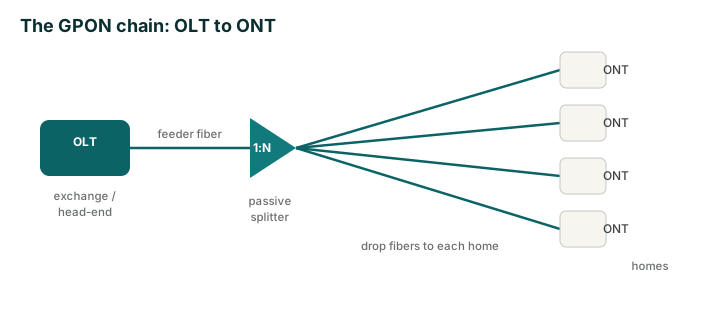
The Optical Line Terminal lives in your exchange, data centre or point of presence. It is the only powered, managed device in the access path, and it does three jobs at once. First, it is the aggregation point — each OLT PON port terminates one optical tree and a chassis holds many ports, so a single OLT can serve thousands of subscribers. Second, it enforces policy: each subscriber’s speed profile, VLAN, and service parameters are provisioned here. Third, and most subtly, it is the scheduler.
Downstream (OLT to subscriber) is straightforward: the OLT broadcasts to every ONT on the tree, and each ONT picks out only the frames addressed to it, ignoring the rest. Upstream is the hard part — every ONT shares one fiber back to the OLT, so they cannot transmit whenever they like or their light would collide. The OLT runs a time-division scheme, granting each ONT short, scheduled windows to transmit. This dynamic bandwidth allocation is why a 1:32 tree does not simply give every subscriber 1/32 of the line rate — idle ONTs surrender their slots to active ones, so a single busy household can momentarily use most of the upstream.
The passive splitter: why ‘passive’ is the magic word
Between the OLT and the homes sits one or more optical splitters. A splitter is a remarkably dumb device: it takes the light arriving on one input fiber and divides it among many output fibers, with no power, no electronics and nothing to fail electrically. That is precisely what makes GPON’s outside plant cheap to build and reliable to run — there is nothing in a roadside enclosure to power, cool, configure or reboot.
Common split ratios are 1:8, 1:16, 1:32 and 1:64. The ratio is a direct trade-off: a higher split packs more homes onto one OLT port (lower cost per subscriber) but divides the optical power further and shares the bandwidth among more users. Splitting is also the single largest source of optical loss in the network — and that loss is unavoidable physics, not a defect. A 1:32 split costs roughly four times the power penalty of a 1:8, which is why split ratio, fiber distance and the optical power budget must all be designed together. See understanding optical power budget for how those numbers combine.
ONU vs ONT: the distinction operators actually use
At the customer end sits the device that converts light back into Ethernet. Two terms describe it, and they are often used interchangeably, but there is a meaningful distinction worth keeping straight:
- ONT (Optical Network Terminal) typically refers to the unit serving a single subscriber, where fiber terminates and the user plugs in directly — often with Ethernet ports, Wi-Fi and voice ports integrated into one box.
- ONU (Optical Network Unit) is the more general term, and in strict usage refers to a unit where the optical signal terminates at a shared point and the final reach to several users continues over another medium — copper, in-building Ethernet, or coax.
In day-to-day operations many ISPs simply call the customer device the ONU or ONT and move on; the distinction matters most when you are reasoning about topology — whether fiber reaches each home (closer to FTTH) or stops at a building and shares the last stretch (closer to FTTB). The companion guide on FTTH, FTTB and FTTC maps these terms onto deployment models.
The full chain, end to end
Putting it together, light flows along a predictable path. Each segment is a place where loss accumulates and where faults occur:
| Component | Where it sits | Role | Powered? |
|---|---|---|---|
| OLT | Exchange / POP | Aggregation, policy, upstream scheduling, monitoring | Yes |
| Feeder fiber | Exchange to field | Trunk carrying the shared signal toward the neighbourhood | No |
| Splitter | Cabinet / closure | Divides one fiber among many subscribers | No |
| Distribution & drop fiber | Field to premises | Final reach from splitter to each home | No |
| ONT / ONU | Customer premises | Converts light to Ethernet/Wi-Fi; terminates the service | Yes |
The mental model is: OLT to feeder fiber to splitter to drop fiber to ONT. The OLT authenticates and rate-limits each ONT; the splitter shares one fiber passively among many homes; the ONT hands the customer a normal Ethernet and Wi-Fi connection. For the broader family of access architectures this PON tree sits within, see choosing your last-mile technology.
How it fails in production
Almost every fiber fault you will ever chase reduces to one symptom: not enough light arriving where it should. The dramatic full cut — a backhoe through a duct — is the rare, obvious case. The common cases are quiet and cumulative. A dirty or loosely seated connector at a patch panel adds loss invisibly. A drop cable kinked behind furniture or stapled too tight bleeds light at the bend. Moisture seeping into a poorly sealed closure slowly degrades a splice. A failing ONT optic transmits weaker and weaker until the link drops.
Because the splitter is shared, the location of a fault tells you its blast radius. A problem on the feeder fiber or at the splitter input takes down every subscriber on that tree at once — a clear signal it is upstream of the split. A problem on one drop fiber or one ONT affects exactly one customer. This single rule — many down together means upstream, one down alone means the drop or the ONT — resolves most dispatch decisions before anyone leaves the office. The OLT’s per-ONT optical readings let you confirm which case you are in without guessing.
Safe ranges and what ‘normal’ looks like
You do not need to memorise exact figures, but you should record what normal looks like on your plant. Every ONT has a manufacturer-specified received-power range; readings comfortably inside that window are healthy, readings near the lower edge are marginal, and readings below it mean errors or no link. The useful habit is baselining: capture each subscriber’s received power at install, store it, and compare against it later. A drop that reads several dB worse than its install baseline is a degrading connector, a new bend, or a tiring optic — found on a maintenance schedule rather than at 2 a.m.
Why inventory turns chaos into a lookup
None of this fault reasoning works without knowing the topology. If you cannot answer “which ONTs hang off splitter X, which hangs off OLT port Y” instantly, every outage starts with reconstruction work. Keeping an accurate, current map of OLT port to splitter to subscriber — and the optical baselines along each path — turns impact analysis from detective work into a query. When a feeder goes dark you immediately know exactly which customers are affected, can notify them proactively, and can dispatch to the one closure that matters. A live network map that ties subscribers to the OLT port and splitter feeding them is what makes that lookup instant during an outage.
The takeaway
GPON earns its reliability and low cost from one idea: push all the intelligence and power to the two ends — the OLT and the ONT — and keep everything in between passive. Internalise the chain, understand that the splitter is both your cost lever and your biggest optical loss, learn the difference between a tree-wide fault and a single-drop fault, and keep an inventory that maps every subscriber to its port and splitter. Do that, and the access network stops being a source of mystery outages and becomes the most predictable part of your operation.