
FTTH, FTTB and FTTC: Fiber Deployment Models Explained
“We’re a fiber ISP” is a sentence that hides an important detail: how far the glass actually reaches before the signal hands off to another medium for the final stretch. A network where fiber terminates on the customer’s wall and one where fiber stops at a street cabinet and the last few hundred metres ride decades-old copper are both, loosely, “fiber” — yet they deliver radically different capacity, cost and longevity. The family of FTTx terms exists precisely to make that distinction explicit.
The choice is not academic. How far you push fiber determines your build cost per premises, the speed ceiling each customer can ever reach, how the network ages, and how often you will be back in the same street upgrading. Push fiber all the way and you build the most capable and durable network at the highest upfront cost; stop short and you build faster and cheaper but inherit the limits of whatever medium covers the final stretch. Matching the model to the property type and your timeline is one of the most consequential decisions an access operator makes.
FTTH — Fiber to the Home
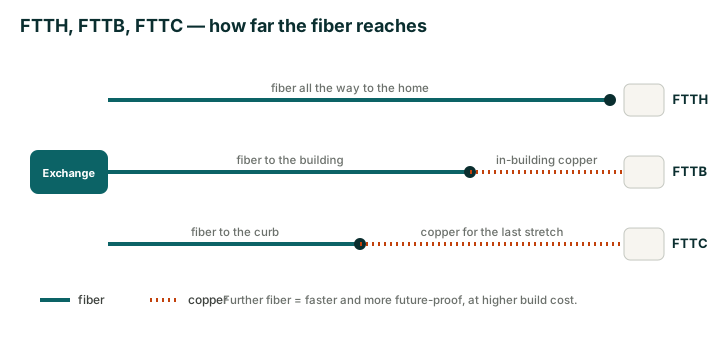
In Fiber to the Home, the glass runs all the way to the subscriber’s premises and terminates in an ONT on the wall. There is no copper or shared in-building medium in the path — fiber to the door, full stop. This is the gold standard: the highest achievable speeds, the lowest and most stable latency, and the most future-proof architecture, because capacity upgrades happen by changing the optics at each end rather than by re-cabling. A home connected with FTTH today can serve growing demand for years without a technician ever returning to the cable.
The cost is the highest of the three and the timeline the longest, because you are building fiber to every individual door — drop installs, terminations and an ONT per premises. Where customers will stay for years and density or revenue justify the spend — new builds, premium areas, greenfield estates — FTTH is the build that does not need redoing.
FTTB — Fiber to the Building
In Fiber to the Building, fiber reaches a shared termination point inside a structure — typically a basement, comms room or riser — and the final stretch to each individual unit reuses the building’s existing internal wiring, whether Ethernet or copper. FTTB is the natural fit for apartment blocks, office buildings and other multi-dwelling units: you bring most of fiber’s benefit right into the building while avoiding the cost and disruption of pulling new fiber to every flat.
The trade-off is that per-unit performance now depends on that final in-building medium. Good structured Ethernet over short internal runs performs close to full fiber; aging shared copper does not. FTTB concentrates the expensive fiber build at one economical point per building and lets the existing risers do the last few metres — an efficient compromise where running glass to every unit would be prohibitive. The device terminating fiber at that shared point is usually described as an ONU rather than an ONT; the distinction is covered in OLT, ONU and ONT explained.
FTTC — Fiber to the Curb / Cabinet
In Fiber to the Curb (or Cabinet), fiber runs to a street-side cabinet serving a cluster of nearby homes, and the final hundreds of metres to each premises ride existing copper. FTTC is cheaper and faster to deploy wherever usable copper is already in the ground, and it genuinely improves on pure copper by dramatically shortening the copper loop — and copper performance falls with distance, so a shorter run means a higher rate.
But FTTC inherits copper’s fundamental limits. Speed still degrades with the remaining copper distance and with the cable’s condition, and there is no clean optics-swap upgrade path comparable to fiber. It is best understood as a stepping stone — a way to lift service quickly in a copper-served area while you plan to push fiber deeper later — rather than a final destination. It sits within the broader spectrum of access choices covered in choosing your last-mile technology.
Comparing the models
| Model | Fiber reaches | Final stretch | Speed ceiling | Relative cost / time | Best fit |
|---|---|---|---|---|---|
| FTTH | The premises | None — fiber to the ONT | Highest, optics-upgradable | Highest | New builds, premium, greenfield |
| FTTB | The building | In-building Ethernet / copper | High, depends on internal wiring | Moderate | Apartment blocks, offices, MDUs |
| FTTC | The curb / cabinet | Existing copper loop | Moderate, falls with distance | Lowest | Upgrading copper areas quickly |
The pattern is consistent: speed and future-proofing rank FTTH over FTTB over FTTC, while cost and time to deploy rank in the reverse order. The further fiber goes, the more you pay and the longer you wait — and the less likely you are to be back upgrading that street within a few years.
How to choose
Match the model to the property and the timeline rather than to ideology:
- FTTH where customers will stay for years and density or revenue justify the build — new developments, premium segments, anywhere you can build once and not return.
- FTTB to light up multi-dwelling units efficiently, reusing internal wiring instead of pulling fiber to every flat. Check the condition of the in-building medium first, because it sets the ceiling.
- FTTC where existing copper lets you raise service quickly and cheaply while you plan deeper fiber — explicitly as a transitional step, not a permanent answer.
Most ISPs run a blend across their footprint and migrate toward FTTH over time as areas mature and capital allows.
How the models fail in production
The deployment model you choose also shapes the kind of faults you will chase, because it determines where the weakest link sits. In FTTH, the fiber path is end to end, so faults are optical and localised — a degraded drop, a dirty connector at the ONT, a bend in the last span — and they are isolated to one subscriber and one clean path to inspect. In FTTB and FTTC, the most common complaints often originate not in the fiber at all but in the final non-fiber stretch: tired riser copper in a building, a long or corroded loop from a cabinet, in-building wiring that was never built for data. These produce slow-speed and intermittent complaints that look like network problems on a ticket but are really last-metre problems. The practical consequence is that your fault-isolation discipline must explicitly account for the handoff point — the place where fiber ends and another medium begins is statistically where the trouble concentrates.
Common mistakes
Two errors recur. The first is treating FTTC as a destination rather than a stepping stone — investing in cabinets and copper conditioning, then discovering a few years later that demand has outrun what the copper loop can deliver, forcing the deeper fiber build you deferred. The second is misjudging FTTB’s in-building medium: assuming “fiber to the building” guarantees fiber-class speeds to every unit, when in reality tired shared copper in the risers quietly caps performance and generates complaints that look like network faults but are really last-metre faults. In both cases the fix is to be honest at design time about where the real bottleneck sits, and to record the handoff medium per building so your support team knows what they are actually troubleshooting.
The takeaway
FTTH, FTTB and FTTC are not competing brands — they are points on a single dial that controls how far you push fiber before handing off to another medium. Pushing further costs more and takes longer but raises the speed ceiling and pushes the next rebuild further into the future. Choose the point that fits each property type and your timeline, be honest about the limits the final stretch imposes, and let yourself migrate the dial toward the home as the economics mature. Whatever model reaches a given customer, they only want reliable speed — and your operations should onboard, monitor and bill them identically regardless of how the fiber got there.