
ISP Network Topologies Explained: Star, Ring, Mesh and Hybrid
The topology of your network — the pattern in which your sites and devices connect to one another — is one of the most consequential decisions you make as an ISP, and one of the hardest to change later. It quietly determines three things you care about deeply: how resilient your service is, how quickly it recovers from a fault, and how much fiber and equipment you must buy to get there.
In practice, no real ISP runs a single, pure topology. Production networks are layered blends. But to design those blends well — and to troubleshoot them at 3 a.m. — you need a clear mental model of the building blocks. This guide walks through the four you'll meet most often, how each behaves when something breaks, and how to choose between them.
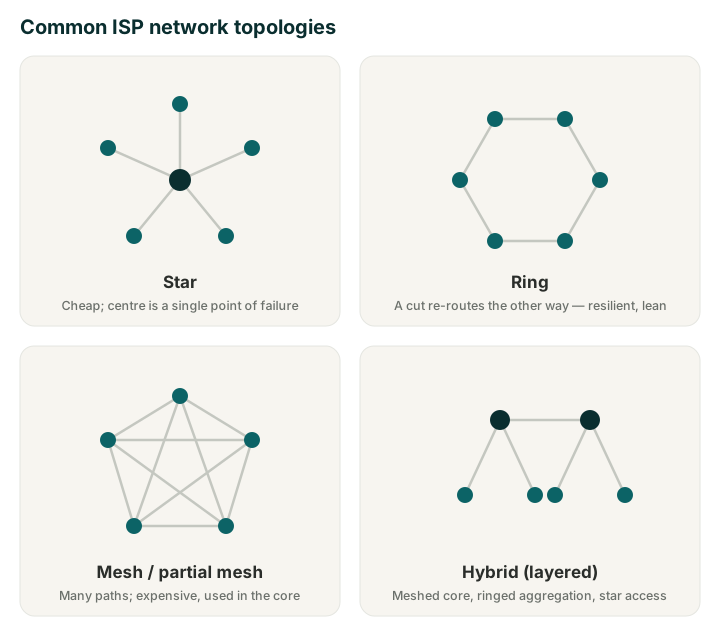
Star (hub-and-spoke)
In a star, every access node connects back to one central point — typically a Point of Presence (POP), an aggregation switch, or your core. It is the simplest topology to build, to document and to reason about, and it is the cheapest because each node needs only a single path home.
How it fails. That single path is also the weakness. The central hub is a single point of failure: if it goes down, everything behind it goes with it. And because each spoke is a lone link, a fiber cut on one spoke isolates the node(s) behind that cut — contained, but with no automatic recovery until someone repairs the fiber.
Where ISPs use it. Star dominates the access edge, where running a second, physically diverse path to every node would cost far more than the outage risk justifies. When a node serves a handful of subscribers, a single well-monitored link is usually the right economic call. Star is rarely the right answer deeper in the network, where one failure affects thousands.
Ring
A ring connects nodes in a loop, so traffic can travel in either direction around it. Its defining property is graceful failure: if a single span is cut, traffic simply re-routes the other way around the ring. With the right protection mechanism, that switchover happens in well under a second — fast enough that most subscribers never notice.
Why it's so popular. A ring delivers most of the resilience of a mesh while using only a little more fiber than a string of point-to-point links. That price-to-resilience ratio is why rings dominate the metro and aggregation layers of most ISP networks. The one rule that makes or breaks a ring: the two directions must follow physically diverse paths. A ring whose two sides share the same duct or pole route is not really a ring — a single backhoe takes out both halves at once.
How it fails. A ring survives any one span failure cleanly. A second simultaneous cut on the same ring, however, can split it into isolated segments — which is why critical rings are kept small or backed by additional paths.
Mesh (full and partial)
In a mesh, nodes interconnect with multiple paths between them. A full mesh — where every node connects directly to every other — tolerates many simultaneous failures, but the number of links (and the cost and operational complexity) grows quadratically as you add nodes. For that reason, true full meshes are rare outside a small, critical core.
The version almost everyone actually builds is the partial mesh: you add extra links only where traffic volume and failure risk justify them. This gives you redundant paths between the parts of the network that matter most, without the unmanageable cost of connecting everything to everything. Partial mesh is the natural shape of a well-designed core.
Hybrid — what the real world looks like
Stitch these together and you get the layered design that virtually every successful ISP converges on: a resilient meshed (or dual-homed) core, rings through the aggregation layer, and stars out to the cost-sensitive access edge.
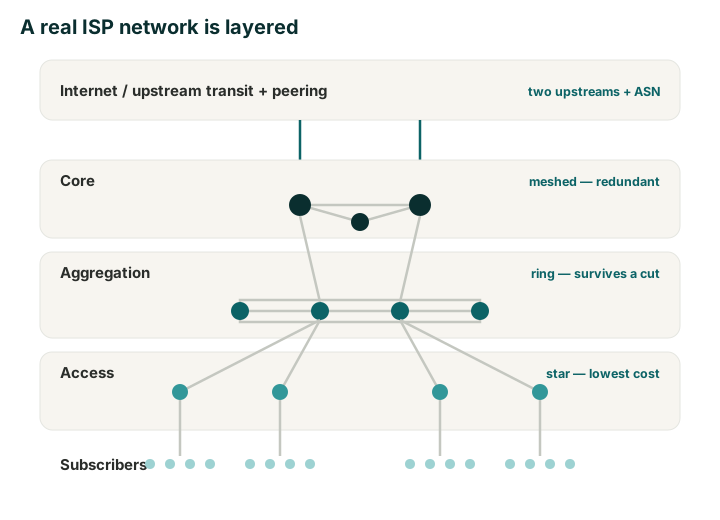
The art of the hybrid is matching protection to blast radius. A failure in the core or a major aggregation ring can affect thousands of subscribers, so those layers earn mesh and ring redundancy. A failure on a single access spoke affects a few customers, so a lean star is the economical, sensible choice. Spending the same on every link — whether by over-protecting the edge or under-protecting the core — is how budgets get wasted and outages get wide.
Side by side
| Topology | Resilience | Relative cost | Complexity | Typical layer |
|---|---|---|---|---|
| Star | Low — hub is a single point of failure | Lowest | Low | Access edge |
| Ring | High — survives any one span cut | Moderate | Moderate | Metro / aggregation |
| Partial mesh | Very high — multiple paths | High | High | Core |
| Full mesh | Highest | Very high (grows with node count) | Very high | Small critical cores only |
How to choose
Topology is ultimately a budgeting exercise — you are buying resilience, and the question is how much, and where. A few decision criteria:
- Blast radius vs. cost: the more subscribers sit behind a node or link, the more a second, diverse path pays for itself. Protect by impact, not uniformly.
- Subscriber density and revenue: high-density, higher-ARPU areas justify ring or mesh; sparse areas often can't.
- Growth: design rings and aggregation so you can insert new nodes without re-architecting the whole layer.
- Path diversity: redundant links that share a duct, pole route or building entrance are not redundant. Verify physical diversity, not just logical.
- Operability: a topology your team can troubleshoot under pressure beats a clever one they can't. Convergence behaviour you understand is worth more than theoretical perfection.
Common mistakes
- A single fiber to a high-value site. A core or aggregation node on one unprotected link is an outage waiting to happen — match protection to what's behind it.
- Rings without true diversity. The most common ring failure isn't two random cuts; it's one cut that severs both sides because they shared a route.
- Over-meshing the access layer. Redundancy the edge doesn't need is just wasted capital that could harden the core.
- No current map. A topology that lives only in one engineer's head turns every fault into a guessing game.
The takeaway
There is no single best topology — there is the right one for each layer, chosen by matching the cost of a second path to the cost of the outage it prevents. Star at the edge, rings through aggregation, mesh in the core: that hybrid is where good ISP networks land, and the discipline is in spending redundancy where it does the most good.
Whichever shape you build, keep it documented and current. A clear, live topology map — one that knows which subscribers sit behind which device — turns a midnight fiber cut from a frantic guessing game into a quick, contained fix. That ability to see, at a glance, exactly who an outage affects is precisely what a good network map and fault-impact view give you, and it's built into ISP Digital's network map.