
Routers, Switches and OLTs: What Each Does in an ISP Network
An ISP network looks complicated from the outside, but it is built from a surprisingly small set of building blocks. Three devices do most of the heavy lifting between a subscriber's home and the wider internet: the switch, the router and the OLT. Each one was designed to make a specific kind of decision, and the cleanest, fastest, most affordable networks are the ones that put each decision where it belongs. The messiest networks are almost always the result of asking one device to do another's job.
This is not pedantry. The distinction between switching and routing, and between access and core, maps directly to cost, performance and how hard your network is to operate at 2 a.m. A switch asked to make routing decisions, or a router asked to do bulk layer-2 aggregation, will technically work and then quietly cost you money, latency and sanity. Understanding what each box is for is the foundation that every later design choice rests on.
Switches: moving traffic within a network
A switch connects devices inside the same network and forwards frames based on hardware (MAC) addresses, segmenting traffic with VLANs. It learns which device lives on which port and delivers frames directly, so conversations between two ports do not bother the rest of the network. In an ISP, switches are the aggregation fabric: they pull together many access links, sit between your access gear and your routers, and carry traffic across a site or a metro area at very high speed.
The defining trait of a switch is that it is fast and relatively simple precisely because it does not make internet-scale decisions. It does not run BGP, it does not choose between upstream providers, it does not translate addresses. It moves frames within a broadcast domain extremely efficiently. Think of switches as the high-speed plumbing inside and between your sites — wide pipes that get traffic from many points to a few aggregation points without applying policy. Because they are simpler, they are cheaper per port and faster at bulk forwarding than routers, which is exactly why you want them doing the bulk forwarding.
Routers: moving traffic between networks
A router connects different networks and forwards packets based on IP addresses, choosing paths with routing protocols. This is where the intelligence of an ISP lives. Routers run BGP to exchange reachability with the rest of the internet, enforce policy about which traffic goes where, manage addressing and translation, and connect your network to upstream transit and peers. Where a switch asks only which port a MAC address is on, a router asks the much harder question of which of many possible paths a packet should take across the whole internet.
In an ISP, routers occupy two roles. At the edge they talk to the outside world — upstreams, peers, exchange points — and apply the policy that decides how your network reaches everyone else. In the core they move traffic between regions and aggregation domains. The subscriber edge, where individual customer sessions are terminated and rate-limited, is a specialised router role often handled by a BNG. If switches are the plumbing, routers are the intersections and traffic signals that decide where everything goes. They are more expensive and more complex per port, which is the price of making decisions the switch cannot.
OLTs: the fiber access head-end
The OLT (Optical Line Terminal) is the device that drives a fiber access network, and it is the box people most often misunderstand because it does not map neatly onto the switch-or-router question. Each OLT port feeds a passive optical network — a single fiber that splits to serve many subscribers, each with an ONU or ONT in their home. The OLT authenticates those subscriber units, enforces each one's speed profile, and schedules traffic on the shared fiber so that one customer cannot drown out the others on the same split. It is, in effect, the head-end of your access network — the place where the part of the network that physically reaches customers begins. Our guide to OLT, ONU and ONT covers the access side in depth.
An OLT has switch-like and router-like qualities, but its essential job is access concentration over fiber: turning one upstream interface into service for hundreds or thousands of homes while keeping each subscriber isolated and rate-controlled. Treating it as just a switch leads you to ignore its subscriber management; treating it as a router leads you to over-spec the wrong thing. Buy and design it as what it is — the fiber access head-end.
How they fit together end to end
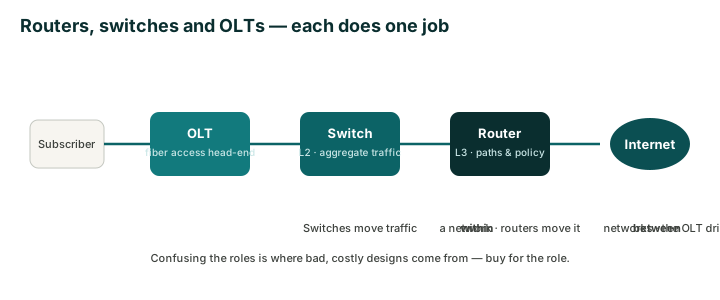
Trace a packet and the roles fall into place. A subscriber's ONT connects over fiber to an OLT, which concentrates many homes and hands their traffic upstream. Aggregation switches gather traffic from multiple OLTs and access devices and carry it efficiently across the site or metro. Routers at the edge apply policy and send traffic out to the internet through transit and peering, while core routers move it between regions. Inbound traffic simply reverses the path. Each device touches the packet only for the kind of decision it is built to make, and the handoffs between them are where a clean design shows its quality.
Where the layers blur, and why that confuses people
Part of why these roles get muddled is that modern boxes deliberately blur the lines. Many switches can do a degree of routing — so-called layer-3 switches — and many routers can switch frames. The hardware overlap is real, but it does not change which decisions each device is good at making at scale. A layer-3 switch can route between local subnets efficiently in hardware, which is genuinely useful inside a site, but it is not where you want full internet routing, complex policy or the heavy address translation that an edge router handles. Likewise a router can move frames, but using a router as your bulk aggregation fabric is paying premium prices for plumbing.
The useful mental test is not what a box can technically do but what it is the right place to do. Layer-2 switching belongs wherever you are aggregating traffic within a network and want maximum forwarding per dollar. Layer-3 routing belongs wherever a decision needs to be made about paths between networks, policy toward the outside world, or address translation. Access concentration over fiber belongs to the OLT. When you find yourself reaching for a feature a box technically has but was not designed around — heavy routing on a switch, bulk aggregation on a router — that is usually the signal that the traffic wants to be handled one layer over. Designing along these lines keeps each device operating in the regime it is fastest and cheapest at, which is what keeps a growing network both performant and affordable.
Device, role and the decisions it owns
| Device | Layer | Primary role | Key decisions it owns | What it should not be doing |
|---|---|---|---|---|
| Switch | Layer 2 | Aggregation within a network | MAC forwarding, VLAN segmentation, bulk transport | Internet routing, NAT, upstream policy |
| Router | Layer 3 | Connecting and policing networks | IP routing, BGP, policy, addressing, edge/core paths | Bulk layer-2 aggregation it would do slowly and expensively |
| OLT | Access head-end | Fiber access concentration | ONU/ONT authentication, per-subscriber rate profiles, PON scheduling | Acting as a general-purpose core router |
Why the distinction matters: common mistakes
Mixing up these roles produces expensive, recurring mistakes. Routing where you should switch makes bulk traffic slow and costly, because you are paying a router to do plumbing a switch does faster and cheaper. Switching where you actually need routing policy leaves you with no control over paths, no clean way to apply upstream policy, and a flat network that does not scale. Under-specifying an OLT's subscriber management, or over-specifying it as if it were a core router, wastes money in one direction or starves the access layer in the other.
The fix is a single discipline: decide which decisions each layer should make, size each device for that role, and resist the temptation to stretch one box across two jobs because it is sitting there. When you are picking the specific router for the edge or core, our notes on choosing a router turn the role into concrete numbers, and a balanced look at vendor trade-offs helps you match a platform to each layer.
The takeaway
Switches move frames within a network, routers move packets between networks and make the hard path decisions, and OLTs concentrate fiber access for many subscribers. Put each decision where it belongs and the network stays fast, affordable and operable as it grows. Get the roles right in the hardware, and the management layer that provisions and bills those subscribers — the part ISP Digital handles — has a clean, well-structured network to sit on top of.