
Peering vs Transit: How ISPs Connect to the Rest of the Internet
Every network on the internet faces the same problem on day one: your customers want to reach destinations you have no direct connection to, and those destinations want to reach back. There are only two mechanisms for solving this — buying transit or arranging peering — and almost every serious ISP ends up using a blend of both. The blend is not a one-time decision. It shifts as your traffic grows, as your traffic mix changes, and as you discover where your packets are actually going.
Understanding the difference matters because it is one of the few levers an ISP controls that simultaneously affects cost, performance, and resilience. Get the mix wrong and you overpay for bandwidth your customers barely use while routing local traffic halfway across a continent. Get it right and your cost per megabit falls every year even as your customer base grows. To do any of this you need your own ASN, your own IP space, and a working understanding of BGP — the routing protocol that makes both transit and peering possible.
Transit: paying for the whole internet
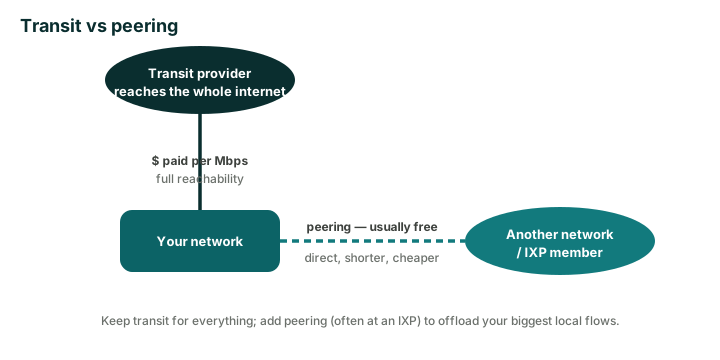
Transit is a commercial service in which an upstream provider agrees to carry your traffic to and from every destination on the internet, and to announce your prefixes to the rest of the world so traffic can find its way back. One transit contract gives you full reachability. That completeness is why almost every ISP starts with transit and why most keep at least some of it indefinitely — it is the safety net that guarantees you can reach anything, even networks you have never heard of.
Transit is usually billed on the volume of bandwidth you push, most commonly measured as the 95th percentile of your five-minute traffic samples over a month. That billing model rewards smooth, predictable traffic and punishes sharp spikes, since a handful of busy intervals can set your bill for the whole month. The transit provider, in turn, makes its money by aggregating many customers and either peering or buying its own transit upstream. You are paying for their reach, their capacity, and their willingness to be your guaranteed path to everywhere.
Peering: swapping traffic directly
Peering is fundamentally different. Two networks agree to exchange traffic destined for each other's customers directly, over a dedicated connection, and in the overwhelming majority of cases neither pays the other — this is called settlement-free peering. Crucially, peering is not transit: a peer carries traffic to its own customers and downstream networks, but it will not carry your traffic onward to the rest of the internet. That is the line that separates a peer from a transit provider.
The economics are compelling when traffic volumes justify it. If a large share of your traffic flows to or from one particular network — a major content provider, a popular video platform, a neighbouring regional ISP — peering with that network moves all of that traffic off your paid transit. The traffic also tends to take a shorter, more direct path, which usually means lower and more consistent latency for your customers. The catch is that peering only covers the specific networks you peer with; everything else still needs transit.
Private peering versus exchanging at an IXP
There are two ways to peer. Private peering is a direct physical link — typically a cross-connect in a shared data centre — between exactly two networks. It is the right tool when a single peering relationship carries enough traffic to justify a dedicated port, because it gives you predictable, uncontended capacity and a clean failure domain. The downside is that every new peer means another cross-connect, another port, and another negotiation.
The alternative, and the entry point for most growing ISPs, is peering at an Internet Exchange Point (IXP). An IXP is a shared switching fabric where you connect once and can then peer with dozens or hundreds of other members over that single port. It dramatically lowers the cost of reaching many peers and is usually the highest-leverage interconnection move a regional ISP can make. Many networks run both models — an IXP port for the long tail of smaller peers, and private interconnects for the handful of partners whose traffic has outgrown the shared fabric.
Comparing the two side by side
| Dimension | Transit | Peering |
|---|---|---|
| Reachability | The entire internet through one provider | Only the peer's own network and its customers |
| Cost model | Recurring, usually 95th-percentile bandwidth billing | Usually settlement-free; you pay for ports and cross-connects |
| Path length | Often longer — up to the provider and back down | Usually shorter and more direct |
| Latency consistency | Variable, depends on provider's network | Typically lower and steadier for peered destinations |
| Setup effort | Low — one contract covers everything | Higher — per-peer agreements and filtering |
| Best for | Guaranteed full reachability and the long tail of destinations | High-volume, local, or content-heavy traffic flows |
How the mix shifts as you grow
A new ISP typically runs on transit alone — one or two providers for full reachability and redundancy. As traffic grows, you start measuring where it actually goes, and patterns emerge: a large fraction heading to a few content networks, a meaningful share staying local. Each of those concentrations is a candidate to move off transit. Joining a local IXP lets you peel away the local and content-heavy traffic onto settlement-free paths, and your transit bill stops tracking your total growth and starts tracking only the long tail of destinations you cannot peer with directly.
The endpoint of this journey, for a large network, is that the bulk of traffic moves over peering and transit becomes a relatively small backstop for the unreachable remainder. Cost per megabit falls year over year even as raw volume climbs. But the transition is gradual and demand-driven — you peer where the traffic justifies it, not everywhere at once.
Resilience: why you keep transit even with heavy peering
Peering improves resilience by adding paths, but it can also create a false sense of security. A peer only advertises its own routes; if your peering session to a content network drops, you need transit (or another peer) to reach that content another way. This is why mature networks treat transit as a permanent insurance layer even when most bytes flow over peering — it is the path that still works when a peering fabric has an outage, when a private interconnect fails, or when a peer withdraws its routes. Running at least two transit providers, ideally with diverse physical paths, protects you from a single upstream failure taking you off the internet entirely.
Common mistakes and how to choose
The most common mistake is treating peering as a way to save money immediately rather than a way to scale economically. Peering has real fixed costs — ports, cross-connects, the engineering time to manage sessions and filtering — so peering a trickle of traffic loses money. Peer where volume justifies the fixed cost, and let transit handle everything below that threshold. The second common mistake is under-investing in transit redundancy because peering feels like enough; it is not, for the reasons above.
To choose your mix, measure before you commit. Look at where your traffic actually flows, identify the concentrations, and check which of those networks are reachable at a nearby IXP. Start with transit for completeness and redundancy, add an IXP port to capture local and content traffic, and graduate the heaviest single relationships to private peering only when their volume clearly warrants a dedicated link. Pair this with disciplined BGP route filtering so that adding interconnections never turns into accidentally becoming someone's unintended transit.
The takeaway
Transit and peering are not competing philosophies — they are complementary tools, and the art is in the ratio. Transit guarantees you can reach everything; peering makes your heaviest, most local traffic cheaper and faster. Start with transit, add peering as your traffic earns it, and keep transit as a permanent backstop. Track cost per megabit and end-to-end latency as you go, because those two numbers tell you whether your interconnection strategy is actually working. For ISP operators building the billing, capacity, and customer systems around that network, ISP Digital is built to scale alongside this kind of growth.